
FINAL WEEK must end Sunday 22 October

by Eugène Scribe translated & adapted by Anthony Curtis
'Stylish' The Guardian review
|
There are two things you
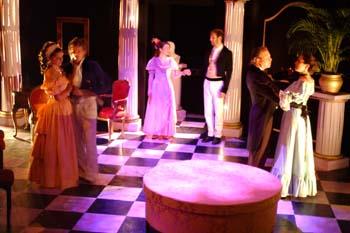
want desperately. You’re offered both but you can only take one. Which will it be? Eugène Scribe takes us on a hilarious journey in the company of three friends (or are they?) as they try to grab a piece of the action. There’s a mysterious lady from Russia, there’s a wedding and there’s big, big money… |
|
with Oliver Chopping |
|
|
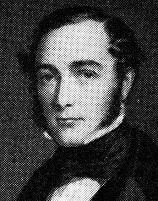 Scribe wrote libretti for Verdi and dozens of hits for the Paris stage; his 150 year old comedy now makes its UK premiere at the Warehouse Theatre. A Jane Nightwork /Warehouse Theatre Company Production |
Ian Shuttleworth in The Financial Times 04.10.06 ****
|
'It is surprising that the English-speaking
world premiere of Eugéne Scribe's 1828 comedy Le mariage
d'argent takes place only now. Surely someone must have spotted
its potential as a zeitgeist-capturing piece during the acquisitive
heyday of the 1980s. Or possibly not, since it may have been
hidden amid the works of the most prolific playwright in history:
before his death in 1861 Scribe had seen more than 400 of his
plays, vaudevilles and opera libretti produced. Moreover, Golden
Opportunities (as the play is entitled in Anthony Curtis's eminently
playable English version) does not exactly toe the "greed
is good" party line. What is particularly impressive,
and consistently fascinating, is its blend of the standard
confections of romantic comedy - rivalries, confusions, misunderstandings
and concealments - with an utterly unsentimental acknowledgement
that wealth can be at least as much of a driving force, and at
least as fulfilling a goal, as love. The financially embarrassed
Poligni is torn between his long-lost sweetheart, the now widowed
and not by any means comfortably off Mme de Brienne, and his
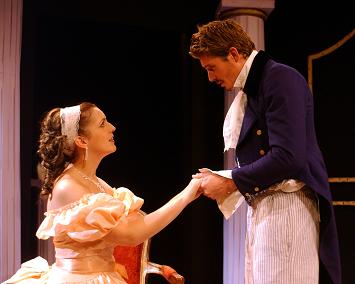
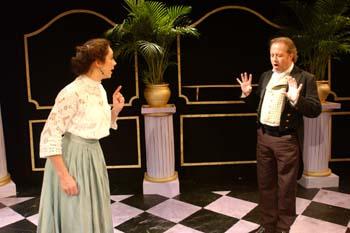
stockbroker friend Dorbeval's vacuous but heavily dowried ward. The third in the male trio, rising painter Olivier, is also in love with Mme de Brienne; meanwhile, Dorbeval's wife has been flirting more than is good for her, and when a too-fervent letter for her arrives and Mme de Brienne pretends that she was its addressee... well, unsurprisingly, entanglements ensue. Yet, throughout, Poligni's sought-for half-million is as much an imperative as any calling of the heart. Roger Ringrose's Dorbeval may be much dimmer at people than at money, but neither trait is culpable: his financial acuity is at the service of people he cares for. Max Digby and Fliss Walton as Poligni and Mme de Brienne have to ride more switchbacks of fortune and emotion than can comfortably be handled, and Sioned Jones as Mme Dorbeval has wonderfully expressive eyes. There is a happy ending of a sort, but the predictable deus ex machina does not by any means produce the expected resolution. Still, as the saying goes, money doesn't buy happiness but it enables you to be unhappy in comfort'. |
top of page autumn season home page